
Every marker we test.And what each one tells you.
Your blood shows how your body is working right now. Here is every marker in our panel, grouped by body system and read alongside your MRI.
Add-onOptional add-on
Blood testing is included in Advanced and Signature. Foundation is scan only.
Brain, lungs and organ structure are read by your MRI scan rather than your blood.
 Cardiovascular and Vascular15
Biomarker
Total cholesterol
The total amount of cholesterol carried in your blood, including both the protective and the harmful types. On its own it says little, so it is read alongside HDL, LDL and ApoB. Unusually low levels are worth noting as well as high ones.
HDL cholesterol
Often called good cholesterol, HDL carries excess cholesterol away from your artery walls and back to the liver. Higher levels are generally linked with lower cardiovascular risk. Regular exercise tends to raise it.
LDL cholesterol
LDL carries cholesterol to your tissues and is the main type that can build up in artery walls over time. Lower levels are linked with a lower risk of heart attack and stroke. Diet, genetics and some medicines all affect it.
Non-HDL cholesterol
Your total cholesterol minus HDL, capturing all the cholesterol in particles that can build up in arteries. Because it includes LDL and other harmful types, it can be a better risk guide than LDL alone. It is accurate without fasting.
Triglycerides
A type of fat your body uses for energy and stores when you take in more than you need. Raised levels are linked with heart disease, insulin resistance and fatty liver. They rise after meals, alcohol and refined carbohydrates.
Apolipoprotein A1 (ApoA1)
The main protein on HDL particles, so it reflects your capacity to clear cholesterol from the arteries. Higher levels are generally protective. It is read alongside ApoB.
Apolipoprotein B (ApoB)
Every particle that can build up in your artery walls carries one ApoB protein, so this counts those particles directly. Many experts see it as a more accurate guide to cardiovascular risk than LDL. It can be raised even when LDL looks normal.
hs-CRP
A sensitive measure of low-level inflammation in the body. Persistently raised levels are linked with higher cardiovascular risk. It can also rise for a few days after an infection, injury or hard training, so it is read in context.
HDL % of total cholesterol
The share of your total cholesterol that is HDL, the protective type. A higher percentage means a more favourable balance. It is calculated from your other results, so no extra blood is needed.
Cholesterol/HDL ratio
Your total cholesterol divided by your HDL. It is the ratio used in UK heart risk calculators. A lower ratio indicates a healthier balance.
LDL/HDL ratio
Compares the cholesterol that can build up in arteries with the cholesterol that helps clear it. A lower ratio suggests a more favourable balance.
LDL-C/total cholesterol ratio
The proportion of your total cholesterol carried as LDL. It shows how much of your cholesterol is in the type most linked with artery build-up.
Non-HDL/total cholesterol ratio
The proportion of your total cholesterol carried by particles that can build up in arteries. A lower proportion is more favourable.
LDL-C/ApoB ratio
Shows roughly how much cholesterol each LDL particle carries. A low ratio suggests smaller, denser particles, which are linked with higher risk even when LDL looks normal.
ApoB/ApoA1 ratio
Compares harmful particles (ApoB) with protective ones (ApoA1). In large population studies it is one of the strongest single blood predictors of heart attack risk. Lower is better.
 Metabolic7
Biomarker
HbA1c
Shows your average blood sugar over the past two to three months, by measuring how much sugar has attached to your red blood cells. It is the main test used to screen for prediabetes and type 2 diabetes. Anything that changes how long red cells live, such as anaemia, can affect the result.
Triglycerides
A type of fat your body uses for energy and stores when you take in more than you need. Raised levels are linked with heart disease, insulin resistance and fatty liver. They rise after meals, alcohol and refined carbohydrates.
hs-CRP
A sensitive measure of low-level inflammation in the body. Persistently raised levels are linked with higher cardiovascular risk. It can also rise for a few days after an infection, injury or hard training, so it is read in context.
Uric acid
A waste product from the breakdown of purines, found in foods such as red meat and seafood, and cleared by your kidneys. Alcohol, sugary drinks, dehydration and hard training can raise it. High levels can cause gout and kidney stones and are linked with metabolic and cardiovascular risk.
Magnesium
A mineral involved in muscle and nerve function, energy production, blood sugar control and bone health. Low levels can contribute to cramps, fatigue and poor sleep. Blood levels do not always reflect total body stores, as most magnesium is held in bones and cells.
Morning cortisol
Your main stress hormone, which helps control blood sugar, blood pressure, inflammation and your sleep-wake cycle. It peaks soon after waking, so it is measured in the morning. A single result is a snapshot, as stress, poor sleep, illness, hard training and test timing all affect it.
DHEA-S
A hormone made mainly by your adrenal glands, which your body can convert into testosterone and oestrogen. Levels peak in your twenties and fall gradually with age. In women, raised levels can be linked with PCOS or with symptoms of excess androgens such as acne and extra hair growth.
 Liver and Digestive8
Biomarker
ALT
An enzyme found mainly in liver cells, released into the blood when they are stressed or damaged. It is the most liver-specific of the routine enzymes. Mild rises are common with fatty liver, alcohol, some medicines and, briefly, after intense exercise.
AST
An enzyme found in the liver and also in muscle and the heart. Raised levels can reflect liver stress, but hard training can raise it too. It is read alongside ALT to work out where a rise is coming from.
GGT
A liver enzyme that is sensitive to alcohol, some medicines and problems with bile flow. Raised levels are also linked with fatty liver and higher cardiometabolic risk. It is often one of the first markers to change when alcohol intake goes up.
Alkaline phosphatase (ALP)
An enzyme made mainly in the liver and bones. Raised levels can point to a bile duct problem or to increased bone turnover, such as during healing. Your other results help show which source is responsible.
Total bilirubin
A yellow pigment made when old red blood cells are broken down, which your liver then clears. Raised levels can reflect liver or bile duct problems, or faster red cell breakdown. A mild, harmless rise is common in Gilbert's syndrome, especially after fasting or illness.
Albumin
The main protein made by your liver. It keeps fluid inside your blood vessels and carries hormones, medicines and nutrients. Low levels can reflect liver or kidney problems, inflammation or poor nutrition, while dehydration can make it read high.
De Ritis ratio (AST/ALT)
Compares your AST and ALT levels. The pattern can help tell apart causes of a liver enzyme rise, such as fatty liver, alcohol or muscle strain. It is most meaningful when the enzymes are raised.
GGT/ALT ratio
Compares your GGT and ALT levels. It can help suggest whether a liver enzyme rise is more likely linked to alcohol or bile flow than to fat in the liver. Like the De Ritis ratio, it is most useful when the enzymes are raised.
 Kidney and Urinary10
Biomarker
eGFR
An estimate of how well your kidneys filter waste from your blood, calculated from your creatinine, age and sex. Lower numbers mean less filtering. People with a lot of muscle can show a falsely low eGFR because they make more creatinine.
Creatinine
A waste product from normal muscle activity, cleared by your kidneys. Higher levels can mean the kidneys are filtering less well, but muscle mass, hard training, creatine supplements and a high-protein meal can all raise it. It is used to calculate your eGFR.
Urea
A waste product made when your body breaks down protein, cleared by your kidneys. Levels rise with dehydration, a high-protein diet or reduced kidney function. Low levels can follow a low-protein diet.
Sodium
A key salt that controls your body's fluid balance and helps nerves and muscles work. A result outside range usually reflects fluid balance, such as dehydration or drinking large amounts of water during endurance exercise. Some medicines, including certain blood pressure tablets, can lower it.
Chloride
A salt that works with sodium to keep your fluid and acid-base balance steady. It usually moves in step with sodium. Changes can reflect dehydration, vomiting or a kidney issue.
Calcium
A mineral essential for bones, muscle contraction, nerve signalling and heart rhythm. Hormones keep blood levels in a tight range, so a result outside it is worth a closer look. Much of it travels bound to albumin, so it is read alongside corrected calcium.
Corrected calcium
Your calcium result adjusted for your albumin level. Because a lot of calcium travels bound to albumin, this gives a truer picture of the calcium your body can use. It is the figure clinicians usually act on.
Total protein
The total amount of protein in your blood, mainly albumin and globulins. It gives a broad view of nutrition, liver and kidney function and hydration. It is most useful as part of the bigger picture rather than on its own.
Globulin
A group of proteins that includes antibodies and transport proteins, worked out as total protein minus albumin. Raised levels can reflect ongoing inflammation or infection. An unusual result may prompt further tests.
Uric acid
A waste product from the breakdown of purines, found in foods such as red meat and seafood, and cleared by your kidneys. Alcohol, sugary drinks, dehydration and hard training can raise it. High levels can cause gout and kidney stones and are linked with metabolic and cardiovascular risk.
 Thyroid and Adrenal8
Biomarker
TSH
A hormone from the pituitary gland in your brain that tells your thyroid how hard to work. High TSH usually means the thyroid is underactive, and low TSH that it is overactive. It is the most sensitive first test of thyroid function.
Free T4
The main hormone made by your thyroid, measured in its active, unbound form. It sets the pace of your metabolism, affecting energy, weight, body temperature and heart rate. It is read with TSH to see how your thyroid is working.
Total T4
All the T4 in your blood: the free form plus the larger amount bound to carrier proteins. Pregnancy, the oral contraceptive pill and oral HRT raise those proteins, which can raise total T4 while free T4 stays normal. That is why free T4 is usually the more useful measure.
Free T3
The most active thyroid hormone, mostly made by converting T4 in your tissues. It helps confirm an overactive thyroid. Illness, very low calorie intake and heavy training can lower it.
TPO antibodies
Antibodies that target an enzyme your thyroid needs to make hormones. Raised levels are the main sign of autoimmune thyroid disease, such as Hashimoto's or Graves' disease. People with raised antibodies but normal thyroid function are more likely to develop thyroid problems later, so are worth monitoring.
Thyroglobulin antibodies
Antibodies against thyroglobulin, a protein your thyroid uses to make its hormones. Like TPO antibodies, raised levels can point to autoimmune thyroid disease. Checking both catches more cases than either alone.
Morning cortisol
Your main stress hormone, which helps control blood sugar, blood pressure, inflammation and your sleep-wake cycle. It peaks soon after waking, so it is measured in the morning. A single result is a snapshot, as stress, poor sleep, illness, hard training and test timing all affect it.
DHEA-S
A hormone made mainly by your adrenal glands, which your body can convert into testosterone and oestrogen. Levels peak in your twenties and fall gradually with age. In women, raised levels can be linked with PCOS or with symptoms of excess androgens such as acne and extra hair growth.
 Reproductive Health14
Biomarker
FSH
A pituitary hormone that drives egg development in women and sperm production in men. In women it changes across the cycle, so the day of your test matters. Raised levels can be a sign of perimenopause or menopause, although in perimenopause they can swing widely from month to month.
LH
A pituitary hormone that triggers ovulation in women and testosterone production in men. It surges mid-cycle, so in women the result depends on timing. LH that runs high compared with FSH can be seen in PCOS.
Oestradiol
The main form of oestrogen, made mostly by the ovaries in women and in smaller amounts in men. It supports bone, heart, brain and reproductive health. In women it varies a lot across the cycle and falls after menopause, while in men high levels can follow excess body fat or testosterone use.
Total testosterone
All the testosterone in your blood. In men it supports muscle, bone, libido, mood and energy, and in women it is present in much smaller amounts with similar roles. Levels are highest in the morning, so the time of your test matters.
Free testosterone
The small fraction of testosterone not bound to proteins, so available for your tissues to use. It is calculated from total testosterone, SHBG and albumin. It is especially useful when SHBG is unusually high or low.
SHBG
A protein that binds testosterone and oestrogen in your blood and controls how much is available. High SHBG means less free hormone and low SHBG means more. The oral contraceptive pill, thyroid function, liver health, insulin resistance and body weight all affect it.
Prolactin
A pituitary hormone best known for stimulating breast milk production. Raised levels can disrupt periods, fertility and libido in both women and men. Stress, poor sleep, some medicines and even the blood draw itself can raise it temporarily.
Free androgen index (FAI)
Compares your total testosterone with SHBG to estimate how much testosterone is available. It is mainly used in women, where a raised result can support a diagnosis of PCOS. It is calculated from your other results.
Testosterone/oestradiol ratio
Shows the balance between your testosterone and oestradiol. In men a low ratio can reflect more testosterone being converted to oestrogen, which is more common with excess body fat. It is calculated from your other results.
Progesterone (female)
A hormone made mainly after ovulation, which prepares the womb lining for pregnancy. A raised level in the second half of your cycle, around day 21 of a 28-day cycle, confirms you have ovulated. At other times a low result is expected and does not mean anything is wrong.
AMHAdd-on
A hormone made by the small follicles in your ovaries, which reflects how many eggs remain, known as your ovarian reserve. It helps with fertility planning, and high levels can be seen in PCOS. It cannot predict whether you will conceive naturally or exactly when menopause will start.
DHEA-S
A hormone made mainly by your adrenal glands, which your body can convert into testosterone and oestrogen. Levels peak in your twenties and fall gradually with age. In women, raised levels can be linked with PCOS or with symptoms of excess androgens such as acne and extra hair growth.
PSA (male)
A protein made by the prostate gland. Raised levels can be caused by prostate cancer, but more often by an enlarged prostate, infection, recent ejaculation or cycling. A GP reviews any raised result alongside your age and other factors before deciding on next steps.
CA-125Add-on
A protein that can be raised in ovarian cancer. It is often raised by non-cancer causes too, such as periods, endometriosis, fibroids and pregnancy, so a raised result does not mean cancer. It is most useful alongside symptoms such as persistent bloating.
 Blood Health16
Biomarker
Haemoglobin
The protein in red blood cells that carries oxygen around your body. Low levels mean anaemia, which can cause tiredness, breathlessness and reduced exercise capacity. Heavy periods, low iron and endurance training can all lower it.
Red cell count (RBC)
The number of red blood cells in your blood. It is read with haemoglobin and haematocrit to check for anaemia or, less often, too many red cells. Altitude, smoking and dehydration can raise it.
Haematocrit
The proportion of your blood made up of red blood cells. Low levels go with anaemia, while high levels can reflect dehydration, smoking or testosterone therapy. It is an important safety check for anyone taking testosterone.
MCV
The average size of your red blood cells. Small cells often point to low iron, while large cells can point to low B12 or folate, alcohol or a thyroid issue. It helps work out the cause of anaemia.
MCH
The average amount of haemoglobin in each red blood cell. It usually moves with MCV, falling with low iron and rising with low B12 or folate. It adds detail when anaemia is present.
MCHC
The concentration of haemoglobin inside your red blood cells. Low levels can reflect iron deficiency. It is mainly useful alongside your other red cell results.
RDW
Measures how much your red blood cells vary in size. A raised RDW can be an early sign of low iron, B12 or folate, sometimes before haemoglobin falls. It also helps tell different types of anaemia apart.
Platelet count
Small cell fragments that help your blood clot. Low levels can increase bruising and bleeding, while high levels can follow inflammation, infection or low iron. Mild changes are common and often temporary.
MPV
The average size of your platelets. Larger platelets are usually younger and more active. It is read with your platelet count to help explain an unusual result.
Ferritin
The protein that stores iron, making it the best single blood measure of your iron reserves. Low ferritin is common in women with periods and in endurance athletes, and can cause tiredness before anaemia develops. Inflammation can raise it and hide low stores.
Iron
The amount of iron circulating in your blood, which your body needs to make haemoglobin. It changes through the day and after meals or supplements. That is why it is read alongside ferritin and transferrin saturation rather than on its own.
TIBC
Measures how much iron your blood could carry if its transport protein were full. It rises when iron stores are low, as your body tries to capture more. Inflammation and liver conditions can lower it.
UIBC
The spare iron-carrying capacity in your blood that is not yet filled. High levels suggest low iron. It is used with your iron result to work out TIBC and transferrin saturation.
Transferrin saturation
The percentage of your blood's iron-carrying protein that is filled with iron. Low levels suggest iron deficiency, while high levels can be an early sign of iron overload such as haemochromatosis. It is calculated from your iron and TIBC.
Folate
A B vitamin needed to make healthy red blood cells and DNA. Low levels can cause anaemia and tiredness, and folate matters especially before and during pregnancy. Leafy greens, pulses and fortified foods are good sources.
Vitamin B12
A vitamin needed for healthy red blood cells and nerves. Low levels can cause tiredness, anaemia, pins and needles and memory problems. People on a vegan diet, older adults and those taking metformin or acid-reducing medicines are at higher risk.
 Immune and Inflammation8
Biomarker
White cell count
The total number of white blood cells, your body's main defence against infection. Raised levels often reflect a recent infection, inflammation, stress or hard exercise. Persistently low or high counts are worth a closer look.
Neutrophils
The most common white blood cells and the first responders to bacterial infection. They rise with infection, inflammation, stress, steroids and intense exercise. Slightly low counts are common and often harmless, particularly in people of Black African or Caribbean heritage.
Lymphocytes
White blood cells that fight viruses and make antibodies. They often rise during and after a viral infection. Low levels can follow illness, stress or very heavy training.
Monocytes
White blood cells that clear away germs and damaged cells and help with tissue repair. They can rise during recovery from infection or with ongoing inflammation. Small changes on their own are rarely significant.
Eosinophils
White blood cells involved in allergic reactions and in fighting parasites. Raised levels are most often linked with hay fever, asthma or eczema. Some medicines can also raise them.
Basophils
The least common white blood cells, which release histamine during allergic reactions. Small changes are common and rarely significant on their own. They are read alongside your other white cell results.
hs-CRP
A sensitive measure of low-level inflammation in the body. Persistently raised levels are linked with higher cardiovascular risk. It can also rise for a few days after an infection, injury or hard training, so it is read in context.
Albumin
The main protein made by your liver. It keeps fluid inside your blood vessels and carries hormones, medicines and nutrients. Low levels can reflect liver or kidney problems, inflammation or poor nutrition, while dehydration can make it read high.
 Musculoskeletal8
Biomarker
LDH
An enzyme found in almost every tissue, including muscle, red blood cells and the liver. Hard training can raise it, as can other kinds of tissue stress. On its own it does not show where a rise comes from, so it is read with CK and your other results.
Creatine kinase (CK)
An enzyme that leaks from muscle into the blood after muscle strain. It is often raised for several days after hard or unfamiliar training, especially strength work or long runs. Very high or persistently raised levels without a clear reason are worth reviewing.
Vitamin D
Helps your body absorb calcium to keep bones and muscles strong, and supports immune function. In the UK many people run low from autumn to spring, when sunlight is too weak to make enough. The NHS advises everyone to consider a 10 microgram daily supplement from October to March.
Magnesium
A mineral involved in muscle and nerve function, energy production, blood sugar control and bone health. Low levels can contribute to cramps, fatigue and poor sleep. Blood levels do not always reflect total body stores, as most magnesium is held in bones and cells.
Uric acid
A waste product from the breakdown of purines, found in foods such as red meat and seafood, and cleared by your kidneys. Alcohol, sugary drinks, dehydration and hard training can raise it. High levels can cause gout and kidney stones and are linked with metabolic and cardiovascular risk.
hs-CRP
A sensitive measure of low-level inflammation in the body. Persistently raised levels are linked with higher cardiovascular risk. It can also rise for a few days after an infection, injury or hard training, so it is read in context.
Calcium
A mineral essential for bones, muscle contraction, nerve signalling and heart rhythm. Hormones keep blood levels in a tight range, so a result outside it is worth a closer look. Much of it travels bound to albumin, so it is read alongside corrected calcium.
Alkaline phosphatase (ALP)
An enzyme made mainly in the liver and bones. Raised levels can point to a bile duct problem or to increased bone turnover, such as during healing. Your other results help show which source is responsible.
 Nutritional Health11
Biomarker
Ferritin
The protein that stores iron, making it the best single blood measure of your iron reserves. Low ferritin is common in women with periods and in endurance athletes, and can cause tiredness before anaemia develops. Inflammation can raise it and hide low stores.
Iron
The amount of iron circulating in your blood, which your body needs to make haemoglobin. It changes through the day and after meals or supplements. That is why it is read alongside ferritin and transferrin saturation rather than on its own.
TIBC
Measures how much iron your blood could carry if its transport protein were full. It rises when iron stores are low, as your body tries to capture more. Inflammation and liver conditions can lower it.
UIBC
The spare iron-carrying capacity in your blood that is not yet filled. High levels suggest low iron. It is used with your iron result to work out TIBC and transferrin saturation.
Folate
A B vitamin needed to make healthy red blood cells and DNA. Low levels can cause anaemia and tiredness, and folate matters especially before and during pregnancy. Leafy greens, pulses and fortified foods are good sources.
Vitamin B12
A vitamin needed for healthy red blood cells and nerves. Low levels can cause tiredness, anaemia, pins and needles and memory problems. People on a vegan diet, older adults and those taking metformin or acid-reducing medicines are at higher risk.
Vitamin D
Helps your body absorb calcium to keep bones and muscles strong, and supports immune function. In the UK many people run low from autumn to spring, when sunlight is too weak to make enough. The NHS advises everyone to consider a 10 microgram daily supplement from October to March.
Magnesium
A mineral involved in muscle and nerve function, energy production, blood sugar control and bone health. Low levels can contribute to cramps, fatigue and poor sleep. Blood levels do not always reflect total body stores, as most magnesium is held in bones and cells.
Calcium
A mineral essential for bones, muscle contraction, nerve signalling and heart rhythm. Hormones keep blood levels in a tight range, so a result outside it is worth a closer look. Much of it travels bound to albumin, so it is read alongside corrected calcium.
Corrected calcium
Your calcium result adjusted for your albumin level. Because a lot of calcium travels bound to albumin, this gives a truer picture of the calcium your body can use. It is the figure clinicians usually act on.
Albumin
The main protein made by your liver. It keeps fluid inside your blood vessels and carries hormones, medicines and nutrients. Low levels can reflect liver or kidney problems, inflammation or poor nutrition, while dehydration can make it read high.
 Cancer Screening4
Biomarker
PSA (male)
A protein made by the prostate gland. Raised levels can be caused by prostate cancer, but more often by an enlarged prostate, infection, recent ejaculation or cycling. A GP reviews any raised result alongside your age and other factors before deciding on next steps.
CA-125Add-on
A protein that can be raised in ovarian cancer. It is often raised by non-cancer causes too, such as periods, endometriosis, fibroids and pregnancy, so a raised result does not mean cancer. It is most useful alongside symptoms such as persistent bloating.
CA19-9Add-on
A protein that can be raised in some cancers of the pancreas, bile ducts and bowel. Gallstones, pancreatitis and liver conditions can raise it too, and some people do not make it at all. A raised result is a prompt for review, not a diagnosis.
CEAAdd-on
A protein that can be raised in some cancers, especially bowel cancer. Smoking, inflammatory bowel disease and liver conditions can also raise it. It is mainly used to monitor known cancer, so in people without symptoms it is always read in context.
There is no general blood test for cancer. These markers have well-documented limits in people without symptoms, so a GP reviews them in context.
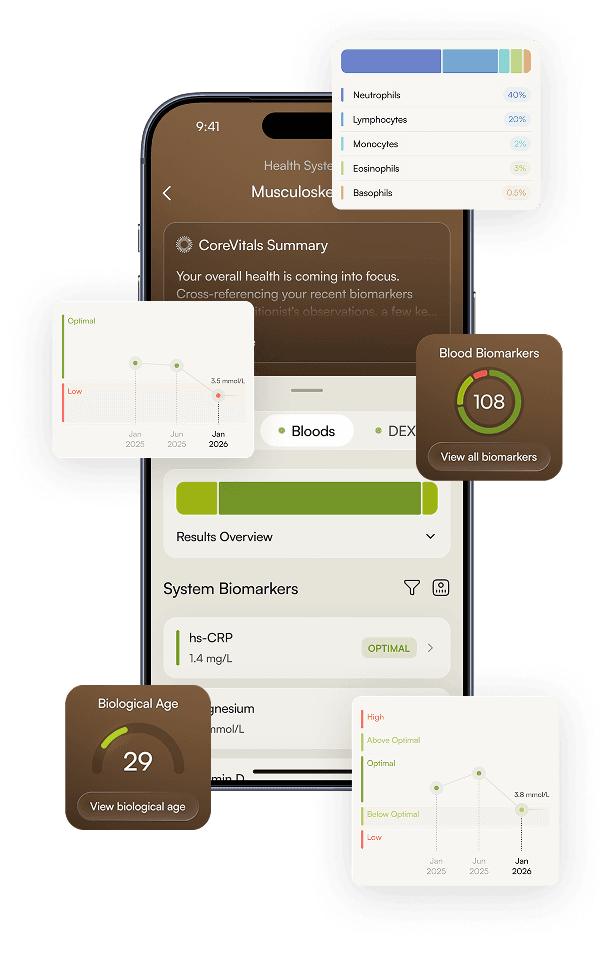
Results delivered in-app
See each biomarker result, historical value charts, biological age and summaries.
Choose a package