
Private cancer screening
Most cancers are found because someone went looking.
The cancers that kill quietly, pancreatic, kidney, ovarian, liver, don't have a national screening programme, and they rarely give you early symptoms. By the time they announce themselves, your options have usually narrowed.
CoreVitals screens your major organs with a whole body MRI, reads it alongside blood testing, and gives you a doctor to explain what it actually means. Not a report sitting in your inbox. An appointment, a conversation, and a plan.
- From £1,350
- Registered clinics nationwide
- We arrange your referral
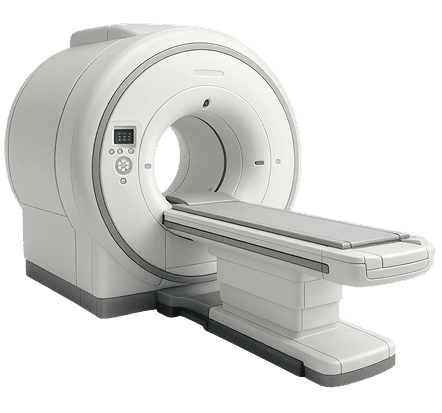
How your scan is built
Skull base to mid thigh. No contrast dye, no injection, no IV line.
We start with a whole body survey. Localisers using mainly T2 imaging across the full field, quick to obtain and good at showing general tissue detail over a large area, the core coverage for spotting lesions anywhere between your skull base and thighs.
Then we add targeted, higher resolution imaging wherever a survey alone isn't enough:
- Brain
- FLAIR, diffusion weighted imaging and a side view T1 scan of brain structure, plus MR angiography of the circle of Willis, which screens the vessels at the base of your brain for aneurysm and narrowing. Most whole body screens skip dedicated intracranial angiography altogether.
- Neck and Thyroid
- Dedicated sequences from skull base to thoracic inlet, covering your thyroid, salivary glands and lymph nodes.
- Liver
- T1 Dixon, which actually characterises your liver tissue and quantifies fat rather than just noting that something looks off.
- Pelvis and Prostate
- Diffusion weighted imaging with ADC mapping, which raises sensitivity for pelvic and prostate pathology.
- Spine (Advanced and Signature)
- Sagittal STIR and T1 across your cervical, thoracic and lumbar regions, covering disc, cord, vertebral body heights and marrow.
- Chest
- Covered within the whole body survey, looking for lung nodules, fluid around the lungs, and enlarged lymph nodes.
And then we read it against your blood. That's the part a scan only service simply can't do.
What we look for

Your images are read by a consultant radiologist, looking for masses, lesions and structural change across:
- Brain and Spinal Cord
- Tumours, pituitary macroadenomas and optic nerve lesions, plus spinal cord masses on Advanced and Signature.
- Head, Neck and Thyroid
- Thyroid nodules, noting presence and any features that warrant further assessment, pharyngeal and tonsillar tumours, neck lymph nodes.
- Chest
- Lung masses, lung nodules above 10mm, central airway masses, pleural and chest wall masses, mediastinal masses.
- Liver, Gallbladder and Digestive Tract
- Suspicious and indeterminate liver lesions, colonic masses and strictures, gastric and small bowel masses, gallbladder masses, peritoneal and mesenteric masses.
- Kidneys and Bladder
- Indeterminate renal masses, complex renal cysts, bladder wall masses.
- Prostate, Uterus and Ovaries
- Suspicious prostatic lesions, ovarian masses and atypical cysts, endometrial thickening, uterine and cervical masses.
- Bone, Marrow and Soft Tissue
- Malignant and indeterminate bony lesions, marrow infiltration, myeloma, intramuscular masses.
- Lymph Nodes
- Head and neck, chest, abdomen, pelvis and groin.
Most findings turn out to be benign. Identifying one is the start of a conversation, not a diagnosis.
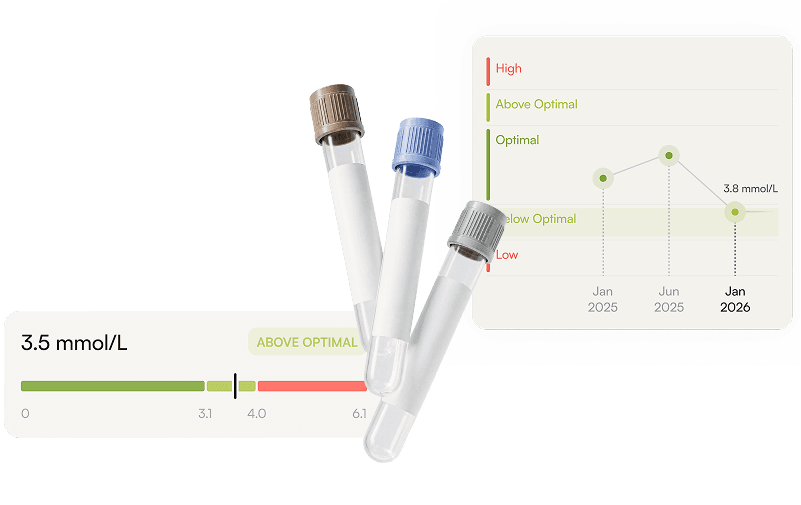
And what we measure in blood
Every competitor selling a cancer scan is selling you a scan. We read imaging and blood together, because they're answering different questions.
None of this is a cancer test. What it gives the doctor reading your scan is a second, independent source of information about your body. Blood testing is included from Advanced.
What you get
- Your referral, arranged. Private imaging in the UK needs one. Our doctors review your history and sort it, no trip to your own GP required.
- Your scan at a CQC registered clinic, with clinics nationwide and scanning typically arranged within 1 to 3 days.
- A consultant radiologist report. Every image read by a consultant.
- Doctor consultations. One to three, depending on your plan, after your results come in. Someone actually explains the report to you.
- A personalised monitoring plan. What's fine, what to keep an eye on, what needs action.
- Onward referral support. If something needs following up, we arrange it. You're not sent back to a GP who's never seen your images.
- Your results in the app, tracked, so this year's scan actually means something next to next year's.
What this doesn't cover
Read this before you choose a plan.
- Breast Cancer
- Breast tissue is not imaged on any plan. Continue attending NHS breast screening when invited. Signature's genetic panel reports inherited breast cancer risk, which is a different thing from imaging your breast tissue, and your doctor consultation covers what to do with that.
- Cervical Cancer
- A scan can show a gross cervical mass, but by the time it's visible on a scan, it may already be established disease. It can't show the early cell changes a smear test picks up. Keep attending cervical screening.
- Early Bowel Cancer
- We can see colonic masses above roughly 3cm. We don't see the lining of the bowel, where cancer actually starts, and our protocol doesn't use oral contrast to distend the bowel. The NHS stool test catches what imaging can't.
- Prostate, with a distinction worth understanding.
- Your pelvic imaging includes diffusion weighted sequences, which raise sensitivity for prostate pathology, and PSA is included in the blood panel on Advanced and Signature. This isn't a multiparametric prostate MRI, which uses contrast and is a diagnostic investigation rather than a screening one. If your PSA or your imaging raises a question, that's the next step, and we'll arrange it.
- Small Lung Nodules
- MRI resolves lung nodules from around 10mm upward. Low dose CT is the established method for lung cancer screening, and if you're a current or former heavy smoker, it's worth asking your GP about it directly.
- Most Blood Cancers
- Largely invisible to imaging in their early stages.
- Skin Cancer
- Only picked up where a lesion happens to fall within the imaged area. See a dermatologist for anything skin related.
- And the honest one
- Screening healthy people finds things. Most are harmless. Some are uncertain and lead to further scans, and occasionally to procedures that turn out to have been unnecessary. That's the real cost of screening. It's also why every plan here includes a doctor, not just a report.
A clear scan is a statement about today. It's not a guarantee, and it's not a substitute for seeing a doctor about a symptom.
Choose your plan
Foundation (£1,350)
or 3x £450 with

Brain, neck, chest, abdomen and pelvis. The organs where silent cancers are most often found. Blood testing isn't included in Foundation, so PSA is excluded.
Advanced (£1,850)
or 3x £617 with
Adds your full spine, meaningfully widening the area imaged, plus blood testing across 13 body systems, including PSA for men, twice a year. Most popular.
Signature (£3,350)
or 3x £1,117 with
Everything in Advanced, plus a CT calcium score, DEXA body composition, and polygenic risk scoring, which includes inherited risk for melanoma and colorectal cancer, with breast, ovarian and pancreatic cancer on the women's panel and prostate cancer on the men's.
How it works

Join and get your referral
Choose your plan online. Our doctors review your medical history and issue your referral.
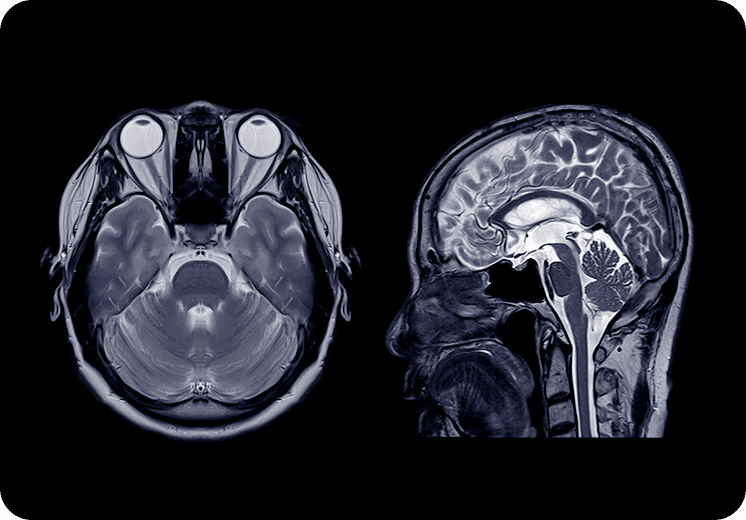
Your MRI
One visit to your chosen clinic. Bloods and any additional assessments are booked separately, near you.
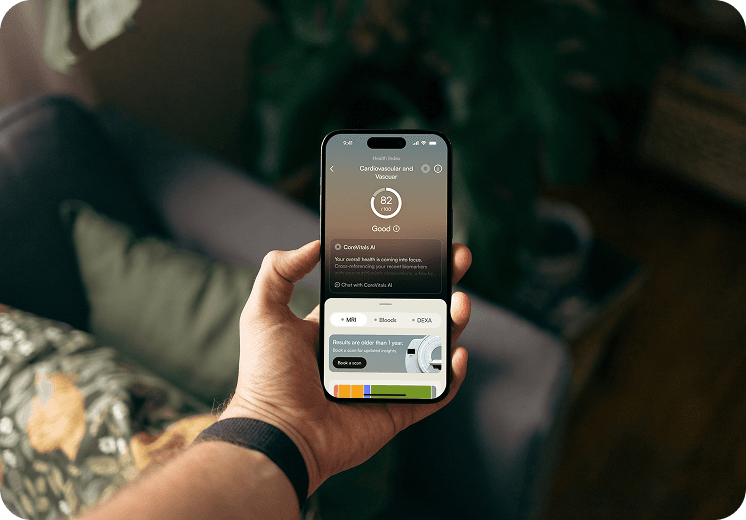
Results in the app
Within 5 working days, your interactive radiologist report, images and blood results, read together.

Your consultation and plan
A doctor talks you through it and builds your monitoring plan.
Track and retest
Each scan builds on the last, so change is visible rather than guessed at. We recommend a rescan every two years under 40, and every year from 40 - or every year at any age if your scan showed something worth watching.
Where you can be scanned
Registered clinics nationwide.
Where you can be scannedFrequently asked questions
We've compiled a list of the most frequently asked questions to help you get the information you need.
- How much is private cancer screening in the UK?
- Prices generally run from around £1,350 to £2,400 depending on scope. CoreVitals plans start at £1,350, with Klarna available. Most comparable whole body services sit between £1,750 and £2,395 and cover the scan alone.
- Do I need a GP referral?
- Private imaging in the UK requires a referral. Some providers self refer. We arrange yours through our own doctors, which means a clinician reviews whether the scan is appropriate for you before it is booked.
- How long does the scan take?
- Around 45-60 minutes on Foundation. 60-90 minutes on Advanced and Signature, which add the full spine.
- Does it use radiation?
- The MRI does not, it uses magnetic fields. The CT calcium score on Signature does involve a low dose, and it is a cardiovascular assessment rather than a cancer one.
- How quickly will I get results?
- Within 5 working days for your scan and bloods. Signature's genetic results follow about a month after the lab receives your sample.
- What happens if something is found?
- A consultant radiologist reports it, a doctor explains it, and we arrange onward referral where it is needed. Most findings are benign.
- Is this better than NHS screening?
- No, and it is not a replacement. NHS programmes target specific cancers with methods proven to reduce deaths from them. This covers more of the body, less specifically. Do both.
- I have symptoms. Should I book?
- No. See a doctor. Screening is designed for people without symptoms, and an NHS diagnostic pathway will investigate a symptom faster, more specifically and at no cost.
- Can I pay monthly?
- Yes, in three instalments with Klarna on every plan.